卑弥呼に関する覚書
Notes on Himiko
Bottle No.3 三種の神器と卑弥呼
Bottle No.2で偉そうに、次回は「東アジアにおける女神信仰」などと書きましたが、これについてはお手上げです。
女性史という分野、特に古代中国や韓国における巫女や巫覡(ふげき)という役割の女性については、記録というものがほとんどなく、民俗学的な研究に俟たなければなりません。
ところが、その研究というのがはかばかしく進んでいない状況で、自分自身にとってもまったく未知の領域です。
愚かにも「少し調べたら何かしら響いてくるものがあるはず」と思ったのが大間違いでした。
そこで「東アジアにおける女神信仰」というテーマについては、後回しにして、まず大和朝廷の「三種の神器」と「卑弥呼」の関りについて、僕の思うところを書き残しておこうと思います。
1.「三種の神器」とは何か?まずは鏡。これは八咫鏡(やたのかがみ)と言われるもので、現在は、伊勢神宮に祀られていますが、天照大神が天岩戸に隠れた際、石凝姥命(いしこりどめのみこと)が天照大神の姿を写して作ったと伝えられているものです。
崇神天皇のころまでは宮中に祀られていましたが、倭迹迹日百襲姫命(卑弥呼)の託宣により、宮中に八咫鏡を置くのは恐れ多いと、宮中から出され、倭姫(やまとひめ)によって大和国から伊賀・近江・美濃・尾張の諸国を経て伊勢の国に運ばれ、ここに伊勢神宮内宮が創建されたと言われています。つづいては剣。天叢雲剣(あめのむらくものつるぎ)、または草薙剣(くさなぎのつるぎ)と呼ばれるものです。天照の弟・素戔嗚尊(すさのおのみこと)が、出雲の八岐大蛇(やまたのおろち)を退治した際、その尾から出てきたとされる鉄剣です。
後の話になりますが、源平合戦で、三種の神器は安徳天皇とともに壇ノ浦に沈み、この草薙剣だけは遂に見つけることができず、新たに造られた複製品が熱田神宮に納められました。最後が勾玉。三種の神器中、唯一、宮中に祀られている「八尺瓊勾玉(やさかにのまがたま)」です。
このため鏡や剣と比べ、格下にみられることもあり、中には「三種の神器ではなく、もともとは、二種の神器ではなかったか?」という研究者もいるようです。
天岩戸伝説では、「岩戸隠れの際に玉祖命(たまのおやのみこと)が作り、八咫鏡(やたのかがみ)とともに太玉命(ふとだまのみこと)が捧げ持つ榊の木に掛けられた」と言われているだけで、何か伝説めいた逸話や、神がかり的な逸話が、まったくと言ってありません。
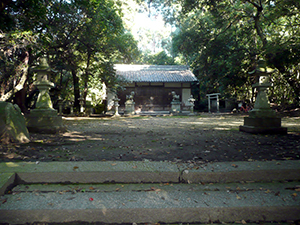
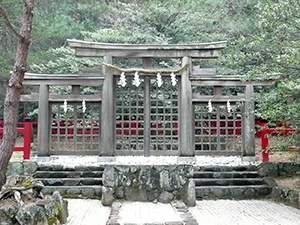
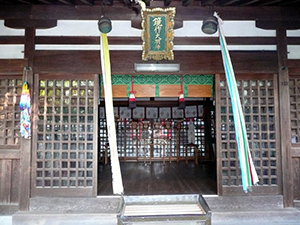
八咫鏡が宮中に置かれていた最後の地・崇神天皇
磯城瑞籬宮跡(奈良県桜井市)八咫鏡が経めぐり祀られた場所は「元伊勢」と言われ
ています。(奈良県桜井市の元伊勢・檜原神社)八咫鏡の鋳型を祀る鏡作坐天照御魂神社
(奈良県田原本市)※付/この稿を書いて以降、鏡と剣の二種の神器が道鏡ゆかりのものということを知った。これを伝えたのが、黄巾党の避難民だと考えれば、なるほどとうなづける話だが、日本で付け足された三番目の「勾玉」の神器、これは日本独自の神器で、皇室にとっていかに大きな意味を持っているかの傍証ともなるようにも感じられる。
2. 八尺瓊勾玉(やさかにのまがたま)が示すものこれに対して僕の「仮説」というか「思い」なのですが、逆に「勾玉」こそが最も重要な神器ではなかったかと感じています。
宮中には、伊勢神宮に祀られている「八咫鏡」も、熱田神宮に祀られている「草薙剣」も共に祀られているのですが、これらはレプリカ(複製品)です。これに対し、「八尺瓊勾玉」のみがオリジナルなのです。
では勾玉は何を表しているのか? それこそは、大和朝廷の統治の基盤となった「稲」もしくは「穀霊」を象徴していると思えるのです。
(ただ、この「勾玉=稲のシンボル」的な発想は、学術的な裏付けがあるわけでなく、僕自身の直感に近い仮説とお考えください。)
だからこそ、この勾玉だけは宮中から出すわけにはいかなかったのではないでしょうか。
稲こそが統治の基盤であり、このため「神嘗祭」や「新嘗祭」などの宮中祭祀が天皇の大きな仕事の一つとなります。そして新天皇が即位後初めて執り行われる「新嘗祭」が、「大嘗祭(おおにえのまつり)」と言って、新天皇の初仕事になるわけです。
古代には、このほかに「国見(くにみ)」という天皇には欠かせない大事な仕事がありました。
以下は、舒明(じょめい)天皇御製の国見の歌になります。大和には 群山(むらやま)あれど
とりよろふ 天の香具山(あめのかぐやま)
登り立ち 国見をすれば
国原は 煙(けぶり)立ち立つ
海原は かまめ立ち立つ
うまし国そ 秋津島 大和の国はまた、仁徳天皇の国見の歌、
高き屋に のぼりて見れば 煙立つ
民のかまどは にぎはひにけりは、あまりに有名です。
このように、「国見の儀式」とは、古代の天皇が、高い場所に登り、国土を見渡して、その豊穣を願う儀式であって、統治の基礎が「稲作」にあることを端的に示す儀式なのです。
このため、穀霊や稲籾を象徴化した「勾玉」は、天皇の傍近くに置くものであって、宮中から出してはいけない神器だと、僕は強く感じています。
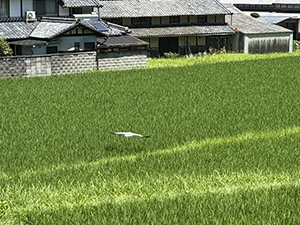
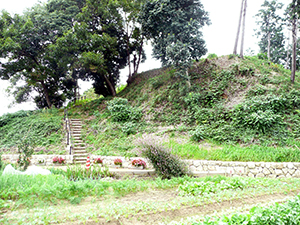
秋津洲と呼ばれた御所市の田園地帯
(奈良県御所市の孝安天皇御陵前)飛鳥時代はこの「雷の丘」が国見の場となった
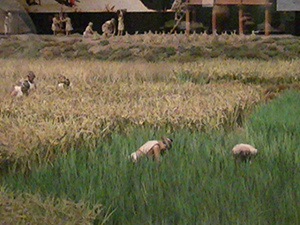
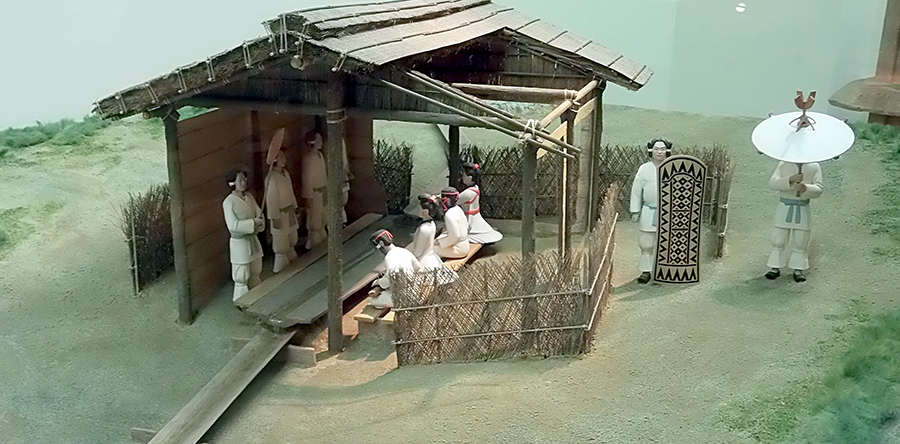
(奈良県高市郡明日香村)卑弥呼の時代/稲作の模様のジオラマ
(大阪府弥生文化館)
3. 卑弥呼と三種の神器いよいよ、今回の覚書の結論ですが、これら「三種の神器」に象徴される「剣」「鏡」「稲」、これを中国から持ち来ったのが「卑弥呼」と「黄巾軍」、それに黄巾党と共に立ち上がった「農民たち」だったのではないかということです。
まず「剣」から見ていきましょう。
この剣に象徴されるのは、「鉄」です。鉄の剣と鉄の装甲で武装された黄巾軍という「武力集団」です。青州黄巾軍の精兵ぶりは、魏の曹操を脅かし、戦うより味方に引き入れるべきと決断させたほどの精鋭軍団です。
天叢雲剣あるいは草薙剣と呼ばれる神器は、銅から鉄への武器革命を意味し、それに出会った人たちの驚きを象徴しているように感じます。次いで「鏡」ですが、黄巾軍のイデオロギーとなる「大平道」(初期道教)の教えが絡んでいるように感じます。
黄巾党が中国の農民の間にあっという間に広がっていった背景に、今で言う「内観」という考え方があります。人は自分と向き合う、自分の中を見ていくことで「病」すら自らの力で癒していくことができる。この教えが中国の農民の間に受け入れられていった、いわば自己回復力を刺激することによる病気直しだと思うのですが、病気を治す方法として、「自分と向き合う」「自分の内面を見つめる」という、今までになかった新しい方向性が示されました。
そして「鏡」という自分と向き合う道具の登場。水に映る姿は別として、鏡の登場で、人は初めて自分と向き合う「道具」を持つようになりました。
「神器」としての「鏡」は、卑弥呼がもたらした初期道教のシンボルだったように思えてなりません。
これまで日本には音を響かせる「神器」としての「銅鐸」がありました。それが黄巾党という異文化の出現で、己を映す「銅鏡」あるいは「鉄鏡」が「神器」として置き換えられていったのではないでしょうか。最後に「勾玉」です。
つまり、三種の神器が象徴する「鉄」「初期道教を基盤とする巫術」「稲作」、これを日本に持ち込んだのが卑弥呼と黄巾党だったというのが、結論とするところです。
勾玉は、先ほど書いたように「稲」あるいは「穀霊」の象徴であり、稲作は国家の根本となる営みです。決して卑弥呼を中心とした黄巾党が稲を伝えたとは言いませんが、稲作の技術となるとどうでしょうか? 稲作はすでに縄文時代から伝わってきていると言われておりますが、灌漑や稲作の技術となると、日本は中国と比べはるかに遅れていたことが想定されます。
そこに地球全体が温暖化に向かい、その移行に伴う気象異変が相次いだように感じます。倭国大乱は、この異常気象が稲作に大打撃を与えることによって起こったとも考えられます。
そこへ中国から最新の農業技術が伝えられました。中国で起こった黄巾の乱とは、黄巾党という宗教集団に先導された農民一揆というのが、その本質です。その構成員の多くは農民なのです。彼らが中国で培った稲作技術が、日本に伝えられ技術革新が起こった。結果、急速に稲作が列島に広がり、国の礎となっていったのではないでしょうか。
この時期の地球温暖化は、過渡期には異常気象等を引き起こし稲作に打撃を与えたと思われますが、気候の安定に伴い、むしろ稲作に良い環境を用意したものと思われます。
そして稲作国家としての大和が誕生し、そのシンボルが「八尺瓊勾玉」だったのではないか、というのが僕の考えです。
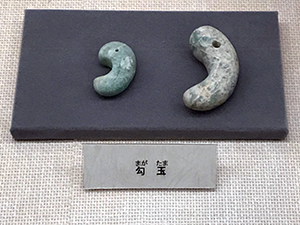
鳥ノ山古墳群 勾玉
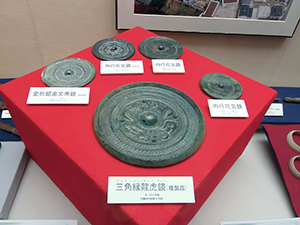
(奈良県橿原考古学研究所蔵)纏向遺跡出土の銅鏡
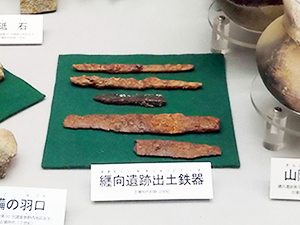
(奈良県桜井市立埋蔵文化財センター)纏向遺跡出土の鉄器
(奈良県桜井市立埋蔵文化財センター)
4. 三種の神器の成立時期
最後に、三種の神器の成立時期についてですが、これは「天照大神」についての覚書で詳しく掲げていく予定ですが、卑弥呼のストーリーから約500年の後、「壬申の乱(672年7月~同年8月)」終結後、すなわち大海皇子がその兄、天智天皇の近江朝を打ち破り、強力な中央集権体制を打ち立てたときになると考えています(あくまで 制度的に整備されたのが、壬申の乱後というように感じています)。
この時、天武の皇后・鸕野讚良(うののさらら)、後の持統天皇ですが、彼女と天武帝の子供たち(特に大伯皇女と大津皇子の姉弟)が中心となって、天照大神こそが最高神で、天皇家こそが、その直系の子孫であるという「天孫降臨神話」を作り出しました。その天照神話には、卑弥呼のストーリーが強く反映しており、その天照神話が作り出される過程で、「三種の神器」が制定されたのではと考えています。これについては、「天照大神」についての覚書で述べるとして、次回は、日本に着いてからの卑弥呼の足取りを追ってみたいと思っています。
古代の水利事業を神事にした「水祭り」の模様/ジオラマ(橿原考古学研究所) 追記
本稿執筆後、三種の神器のうち、鏡と剣が道鏡ゆかりの神器と伝えられていることを知りました。黄巾の乱の難民によってもたらされたと仮定すれば、この説はより説得力を持つものとなります。一方、日本で追加された三種の神器である勾玉は、日本独自の神器であるように思われます。その意味で、勾玉は皇室にとっていかに重要な存在であるかを間接的に物語っているのかもしれません。
Notes on Himiko: Bottle No.3
—The Three Sacred Treasures and Himiko
In Bottle No. 2, I rather boldly announced that my next topic would be "Goddess Worship in East Asia." But I must now admit—I'm at a complete loss.
The history of women, especially the roles of shamans and female spiritual practitioners in ancient China and Korea, is barely documented. The few glimpses we have rely almost entirely on folklore studies. Unfortunately, even those studies remain underdeveloped, and this is a domain I myself know very little about.
In hindsight, it was naïve of me to think that "a little research would surely reveal something meaningful." I was quite mistaken.So instead of tackling the broader topic of goddess worship in East Asia just yet, I'd like to first share some of my thoughts on the relationship between Himiko and the "Three Sacred Treasures" associated with the Yamato court.
1. What Are the Three Sacred Treasures?Let's begin with the mirror. This is the Yata no Kagami, which is currently enshrined at the Inner Shrine of Ise Grand Shrine. According to legend, it was forged by the deity Ishikoridome no Mikoto to reflect the image of Amaterasu, the sun goddess, when she hid herself away in the Heavenly Rock Cave.
Up until the reign of Emperor Sujin, the mirror was enshrined within the imperial palace. However, due to the divine message (takusen) received by Yamatototohimomosohime no Mikoto—believed by some to be Himiko—it was deemed too sacred to keep in the palace. As a result, the mirror was moved by Yamato-hime through various provinces including Iga, Omi, Mino, and Owari, before finally arriving in Ise. There, the Inner Shrine of Ise Grand Shrine was established.Next is the sword—the legendary Ame-no-Murakumo no Tsurugi, also known as the Kusanagi no Tsurugi. It is said that Susanoo no Mikoto, the younger brother of Amaterasu, discovered this iron blade inside the tail of the defeated eight-headed serpent Yamata no Orochi in Izumo.
Later, during the Genpei War, the Three Sacred Treasures were sunk into the sea at the Battle of Dan-no-ura along with Emperor Antoku. Of the three, the Kusanagi sword was never recovered. A replica was later created and is now housed at Atsuta Shrine.Finally, we come to the magatama—a curved jewel known as the Yasakani no Magatama. Of the Three Sacred Treasures, this is the only one still kept within the Imperial Palace.
In the myth of the Heavenly Rock Cave, it is said that the jewel was made by Tamanooya no Mikoto and hung with the Yata no Kagami from a sacred sakaki tree by Futodama no Mikoto to coax Amaterasu out of hiding.
Unlike the mirror and the sword, however, the magatama lacks dramatic or divine legends attached to it.For this reason, the magatama has often been seen as the lesser of the three, and some researchers have even argued that the original regalia may have comprised only two items, not three.
The final site where the Yata no Kagami was enshrined in the Imperial Court — Remains of the Shiki Mizugaki Palace of Emperor Sujin (Sakurai City, Nara Prefecture) The places where the Yata no Kagami was once venerated are known as "Moto-Ise." — Hibara Shrine, a Moto-Ise site in Sakurai City, Nara Prefecture Kagami-tsukuri Shrine, dedicated to the mold used to cast the Yata no Kagami (Tawaramoto Town, Nara Prefecture)
2. What the Yasakani no Magatama RepresentsHere, I'd like to offer a personal hypothesis—perhaps more intuition than theory. I believe the magatama was, in fact, the most important of the Three Sacred Treasures.
While both the mirror and the sword now enshrined at Ise and Atsuta are replicas, the Yasakani no Magatama is said to be the original artifact.So what does this jewel represent? I suspect it symbolizes rice—or more specifically, the spirit of the grain—which formed the foundation of Yamato rule.
(That said, this idea of "magatama as a symbol of rice" is not based on any academic evidence, but rather my own intuitive speculation.)If this is true, then it would make perfect sense that this particular treasure must not be taken out of the palace.
Rice was the basis of imperial rule, and the great court rituals such as the Kannamesai (sacred tasting festival) and the Niinamesai (harvest festival) became central duties of the emperor.
In fact, the first major ritual performed by a newly enthroned emperor is the Daijosai (Great Tasting Ceremony), which is essentially a special form of the Niinamesai.In ancient times, another essential role of the emperor was the Kunimi—ritual surveying of the land.
Here is a poem attributed to Emperor Jomei:Though there are many hills in Yamato,
It is Mount Kagu that rises most nobly.
Ascending it to survey the land,
I see the fields below smoking with life,
The sea shimmering with birds in flight.
Ah, what a wondrous land—our autumn-isle of Yamato!And a famous poem by Emperor Nintoku:
From my high tower I gaze upon the land—
Smoke rising from every hearth,
The people's homes are thriving.These "Kunimi" rituals, in which emperors ascended high places to view and bless the fertility of the land, clearly show that the foundation of governance lay in rice cultivation.
This is why I believe the magatama—symbolizing rice or the grain spirit—had to remain close to the emperor, enshrined within the palace. It was the most sacred treasure of all.
The rural landscape of Gose City, once called Akitsushima — In front of the Mausoleum of Emperor Kōan (Gose City, Nara Prefecture) This "Thunder Hill" served as a site for imperial observation during the Asuka period (Asuka Village, Takaichi District, Nara Prefecture) Diorama depicting rice cultivation in Himiko's era (Yayoi Culture Museum, Osaka Prefecture)
3. Himiko and the Three Sacred TreasuresAnd now we arrive at the central point of this memo.
The three items symbolized by the regalia—the sword, the mirror, and the rice—may have been brought to Japan by none other than Himiko, the Yellow Turban forces, and the farmers who rose alongside them.Let's begin with the sword.
The sword represents iron. The Yellow Turban army was a militarized force equipped with iron swords and iron armor. The elite soldiers from Qingzhou were so formidable that even the mighty Cao Cao of Wei chose to recruit them rather than fight them.
The legendary sword—whether the Ame-no-Murakumo or the Kusanagi—may symbolize the dramatic technological leap from bronze to iron weaponry and the awe it inspired.Next, the mirror.
Here, we encounter the ideology of the Yellow Turban Rebellion: the teachings of Taiping Dao, an early form of Taoism.
One of the key concepts embraced by the Chinese peasants was a form of introspection akin to what we might call "self-reflection" or "inner observation" today. This belief held that by turning inward and facing oneself, one could heal even physical illness.
This new approach—healing through self-awareness—spread rapidly among the people. And with it came the mirror: the first "tool" that allowed humans to face themselves.
Prior to this, water reflections were the only means. But with the appearance of bronze or iron mirrors, people could directly confront their own image.As a sacred object, I believe the mirror symbolized the spiritual insights brought by Himiko and the early Taoist teachings.
Previously, Japan had ritual bells called dotaku, which produced sound to signal the sacred. But with the arrival of a new culture—the Yellow Turbans—the reflective mirror may have replaced the sounding bell as the spiritual artifact of choice.Finally, the magatama.
As discussed, the magatama symbolizes rice or the spirit of grain—foundational to national identity.
I don't mean to suggest that Himiko and the Yellow Turbans introduced rice itself to Japan. Rice cultivation dates back to the Jomon period.
However, in terms of irrigation techniques and agricultural technology, Japan likely lagged far behind China.This was a time when the Earth was undergoing a phase of global warming, marked by abrupt climate shifts.
It's quite possible that the "Civil War of Wa" was triggered by crop failures due to extreme weather, causing unrest among agrarian communities.
Into this unstable world came advanced farming techniques from China.The Yellow Turban Rebellion, at its core, was an uprising of farmers, guided by a religious movement. Most of its members were agriculturalists.
They brought with them the latest rice-farming technology, which triggered an agricultural revolution in Japan.
As a result, rice cultivation spread rapidly across the archipelago, laying the foundation for what would become the Yamato state.Though the early stages of warming may have brought destructive weather, the eventual climatic stability likely created ideal conditions for agriculture.
Thus, the emergence of a rice-based Yamato kingdom—and its emblem, the Yasakani no Magatama—is no coincidence.In short, the Three Sacred Treasures symbolize iron, Taoist-based shamanic thought, and rice cultivation.
It was Himiko and the Yellow Turban movement who may have introduced these elements to Japan.
Magatama (curved beads) from the Torinoyama Kofun Cluster (Collection of the Kashihara Archaeological Institute, Nara Prefecture) Bronze mirror excavated from the Makimuku archaeological site (Sakurai City Center for Buried Cultural Properties, Nara Prefecture) Iron tools excavated from the Makimuku archaeological site (Sakurai City Center for Buried Cultural Properties, Nara Prefecture)
4. When Were the Three Sacred Treasures Instituted?Lastly, a few thoughts on the historical moment when these treasures became formalized.
I plan to explore this further in a future memo on Amaterasu, but for now I'll say this:
Roughly 500 years after Himiko's era, in the aftermath of the Jinshin War (July–August 672 CE), the victorious Prince Ōama defeated his elder brother's Ōmi court and established a powerful centralized government.I believe that it was during this period—after the Jinshin War—that the system of the Three Sacred Treasures was officially established.
At the heart of this initiative were Princess Uno no Sarara (later Empress Jitō) and her children by Emperor Tenmu—particularly Princess Ōku and Prince Ōtsu.
They created the myth of Amaterasu as the supreme deity, positioning the imperial family as her direct descendants.
And within that newly crafted mythos, elements of Himiko's story can be strongly sensed.
It was likely during this myth-making process that the Three Sacred Treasures were canonized.I'll explore this connection in more detail in my memo on Amaterasu.
For now, I plan to turn my attention to the next topic: tracing Himiko's footsteps after her arrival in Japan.
Diorama of the "Water Festival," a ritual based on ancient waterworks (Kashihara Archaeological Institute) Postscript
After writing this piece, I learned that the mirror and the sword—two of the Three Sacred Treasures—are said to be associated with Dōkyō. If we assume that this information was brought by refugees from the Yellow Turban Rebellion, it becomes a plausible and convincing theory. Meanwhile, the third treasure, the magatama (curved jewel), which was added in Japan, appears to be a uniquely Japanese sacred item. In that sense, it may also serve as indirect evidence of just how significant it is to the Imperial Household.